According to Gartner, location-based intelligence is now among the top five data sources retailers use to qualify customer intent – and the gap between businesses using it and those ignoring it is widening every quarter. For retail and local service businesses, that gap translates directly into wasted ad spend, low-conversion foot traffic, and leads that look promising on paper but never buy.
What Is AI Geo-Fencing, and Why Does It Change How Leads Are Qualified?
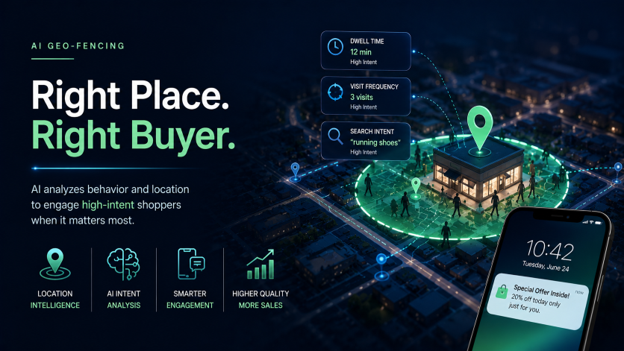
AI geo-fencing is the practice of using artificial intelligence to define virtual geographic boundaries and trigger personalized, context-aware marketing actions when a device enters, dwells within, or exits that boundary. Unlike traditional geo-fencing – which simply fires a generic push notification when someone crosses a line – AI geo-fencing analyzes behavioral signals, dwell time, historical visit patterns, and real-time intent data to determine whether that person is worth engaging, and how.
The distinction matters. Traditional geo-fencing casts a wide net. AI geo-fencing filters while it casts.
Most businesses don’t have a lead volume problem. They have a lead quality problem – and location data, processed through AI, is the most underused filter available to fix it.
Direct Answer
AI geo-fencing improves retail lead quality by combining geographic boundary triggers with AI-driven behavioral analysis. When a device enters a defined zone, the system evaluates intent signals – dwell time, visit frequency, browsing history – to determine whether to engage and how. The result is outreach delivered to high-probability buyers, not just nearby devices, reducing wasted spend and increasing conversion rates.
Key Takeaways
- AI geo-fencing filters leads by intent, not just proximity – targeting people showing purchase behavior, not just physical presence
- Dwell time and visit frequency are stronger intent signals than location alone; AI systems weight these automatically
- Retail businesses using AI-driven location targeting consistently report higher in-store conversion rates compared to broad digital campaigns
- The technology scales from a single storefront to multi-region campaigns without requiring separate strategies for each location
- AI Geo Elite’s Answer Engine Optimization approach integrates location intelligence with natural language processing to capture both physical and voice-search-driven intent
Why Does Traditional Geo-Fencing Produce Low-Quality Leads?
The root cause isn’t the technology itself. It’s the assumption baked into how traditional geo-fencing was designed: that proximity equals intent.
Someone walking past your store while on the phone, someone who parked nearby to visit a different business, someone who crossed your geo-fence boundary while driving at 40 mph – traditional systems treat all of these as equivalent leads. They’re not. And when your CRM fills up with contacts who were never actually interested, your sales team wastes time, your ad budget dilutes, and your conversion data becomes meaningless.
The core problem is that location alone is a weak signal. AI geo-fencing solves this by treating location as one variable in a multi-signal intent model, not as the conclusion.
Behavioral data – how long someone stayed, whether they’ve visited before, what they searched for before arriving – transforms a location ping into an intent score. That’s the mechanism. Not magic. Just better filtering upstream.
How Does Location Targeting Actually Improve Lead Quality?
Here’s the operational reality. When a device enters a geo-fenced zone, an AI system evaluates several variables simultaneously:
- Dwell time: A person who spends 12 minutes near your storefront is statistically more likely to be a buyer than someone who passed through in 45 seconds
- Visit recurrence: A second or third visit to the same zone signals consideration-stage behavior – the AI weights this heavily
- Cross-referencing with search intent: If the device recently queried “best running shoes near me” and is now inside a sporting goods geo-fence, the intent stack is strong
- Time-of-day patterns: Lunch-hour visitors to a restaurant zone behave differently than late-evening visitors; the AI adjusts messaging accordingly
The system doesn’t just identify who is nearby. It identifies who is nearby and likely to convert.
This is why AI Geo Elite’s approach to location-based optimization is built on layered signal analysis rather than simple boundary triggers. The difference in lead quality downstream is significant – practitioners using this approach report that qualified lead ratios improve substantially when intent scoring replaces raw proximity data.
What Are the Real Benefits for Retail and Local Businesses?
1. Reduced Cost Per Qualified Lead
When your targeting filters for intent before triggering an ad or notification, you stop paying to reach people who were never going to buy. A regional home goods retailer using AI-driven geo-fencing reduced their unqualified lead volume by consolidating campaigns around high-dwell zones near competitor stores – a tactic that produced a measurable lift in in-store conversion within 60 days.
2. Competitive Conquest Targeting
One of the most effective applications: placing a geo-fence around a competitor’s location. When someone spends meaningful time at a competitor, the AI flags them as an active consideration-stage buyer and serves a targeted offer. This isn’t new as a concept – but AI makes the intent qualification accurate enough to act on at scale.
3. Voice Search Integration
Here’s what most geo-fencing discussions miss entirely. When someone asks their phone “where can I find a good Italian restaurant near me,” that query is processed by a natural language engine – and businesses optimized for
Answer Engine Optimization appear in those results. AI Geo Elite specifically connects geo-fencing intelligence with AEO strategy, so that location-targeted customers are also the ones finding your business through voice and AI-generated search results.
Geo-fencing captures people who are physically nearby. Answer Engine Optimization captures people who are digitally nearby. The businesses winning in 2026 are doing both simultaneously.
4. Scalability Without Strategy Fragmentation
A single-location retailer and a 40-location chain can both use AI geo-fencing – but the value compounds differently. Multi-location businesses benefit from cross-location behavioral data that improves targeting accuracy across the entire network. The AI learns what high-intent behavior looks like in one market and applies that model to others.
The LIQS Framework: How to Score Location-Based Lead Quality
AI Geo Elite uses a four-variable scoring model for evaluating geo-fencing lead quality, called the Location Intent Qualification Score (LIQS):
| Variable |
Low Signal |
High Signal |
Weight |
| Dwell Time |
Under 2 minutes |
Over 8 minutes |
High |
| Visit Frequency |
First-time entry |
3+ visits in 30 days |
High |
| Pre-Visit Search Intent |
No recent relevant queries |
Queried category within 24 hours |
Medium |
| Time-Context Match |
Off-peak, misaligned timing |
Peak hours, purchase-aligned timing |
Medium |
Use LIQS when: You’re running geo-fencing campaigns across multiple zones and need a consistent framework for prioritizing follow-up or ad spend.
Don’t use LIQS when: Your geo-fence zone is so small or specialized, such as a single trade show booth, that all entrants are already high-intent by definition.
A lead scoring above three high-signal variables warrants immediate, personalized outreach. Two or fewer signals suggests nurture sequencing, not direct sales contact.
How Does AI Geo-Fencing Compare to Other Local Targeting Methods?
| Method |
Intent Signal Strength |
Personalization Depth |
Scale |
Best For |
| Traditional Geo-Fencing |
Low (proximity only) |
Low |
High |
Broad awareness campaigns |
| AI Geo-Fencing |
High (multi-variable) |
High |
High |
Lead quality optimization |
| Keyword-Only PPC |
Medium (search intent) |
Medium |
High |
Digital-first businesses |
| Social Media Targeting |
Medium (behavioral) |
Medium |
High |
Brand engagement |
| Answer Engine Optimization |
High (NLP intent) |
High |
Global |
Voice and AI search visibility |
The honest tradeoff: AI geo-fencing requires more data infrastructure and setup time than running a basic proximity campaign. It’s not a same-day activation. But the businesses that invest in the setup consistently report that their lead quality metrics – not just volume – improve in ways that persist.
Who Is AI Geo-Fencing NOT Right For?
This is important. AI geo-fencing is not a fit for every business, and overselling it doesn’t serve anyone.
It’s not right for you if:
- Your business has no physical location or foot traffic component – the location signal has nothing to anchor to
- Your customer journey is entirely online and asynchronous – the real-time trigger model doesn’t match the buying behavior
- You don’t have the data infrastructure or consent framework to handle location data compliantly under GDPR, CCPA, or applicable regional privacy law
- Your average transaction value is low enough that the per-lead economics don’t justify the setup investment
AI geo-fencing is a precision tool. Precision tools require setup, calibration, and the right use case. Applied correctly, the results are measurable. Applied to the wrong business model, it’s an expensive distraction.
FAQ: Real Questions Buyers Ask Before Committing
How is AI geo-fencing different from just running a local Facebook ad?
Facebook local ads target users based on declared location data and behavioral profiles, but they don’t respond to real-time physical presence. AI geo-fencing triggers based on where someone physically is right now and layers in intent signals from that moment. The result is outreach that’s contextually timed, not just geographically approximate.
How much data does AI geo-fencing need before it starts working accurately?
Most AI geo-fencing systems require a meaningful baseline of location events – typically several weeks of data – before intent scoring becomes reliable. Early campaigns often run broader, then tighten as the model learns what high-conversion behavior looks like in your specific zones.
Is location data collection legal, and how do I stay compliant?
Compliance depends on your geography and how data is collected. In the U.S., CCPA governs consumer data rights in California; GDPR applies across the EU. Any compliant AI geo-fencing setup requires opt-in consent mechanisms and transparent data use disclosures. AI Geo Elite builds compliance checkpoints into its campaign architecture from the start.
Can a small local business afford AI geo-fencing, or is it only for large retailers?
The technology has become more accessible, but the economics still favor businesses with higher average transaction values or repeat purchase cycles. A boutique with a $200 average order value will see better returns than a business with a $15 transaction – not because the technology works differently, but because the margin per converted lead justifies the investment differently.
How long does it take to see measurable improvement in lead quality?
Practitioners report that meaningful quality improvements typically appear within 45 to 90 days, once the AI has enough behavioral data to score intent accurately. Volume may not change immediately – but conversion rates on the leads generated tend to improve noticeably within that window.
Does AI geo-fencing work for businesses targeting both local and national audiences?
Yes, and this is one of its structural advantages. A business with local storefronts and a national e-commerce presence can run geo-fencing campaigns that serve location-specific offers to in-zone visitors while feeding behavioral data back into national targeting models. AI Geo Elite specifically designs campaigns that scale from local precision to global reach without requiring separate strategies.
What happens to leads who enter the geo-fence but don’t convert immediately?
High-quality AI geo-fencing systems don’t abandon non-converting leads – they route them into retargeting sequences calibrated to where the person is in the consideration cycle. Someone who visited twice but didn’t buy gets different follow-up than someone who visited once and left quickly. The AI manages this segmentation automatically.
You Now Know What Most Retailers Won’t Act On Until 2027
The businesses that treat location as a filter – not just a trigger – will outperform those still optimizing for impressions. AI geo-fencing is the infrastructure that makes that filter work.
If you’ve read this far, you’re already thinking differently about what lead quality actually means and where it gets determined. The next step isn’t more research – it’s a strategy built around your specific zones, your customer intent patterns, and your conversion goals.
Download the AI Lead Acquisition Strategy Guide today and get the exact framework AI Geo Elite uses to help retail and local businesses move from broad location targeting to precision intent-based lead generation – including the LIQS scoring model, compliance checklist, and a step-by-step campaign setup sequence. For businesses ready to take the next step,
explore AI Geo Elite’s services to see how location intelligence and AEO strategy are combined into a single campaign architecture.
[Download the AI Lead Acquisition Strategy Guide]
References
- Gartner – Research on location-based intelligence as a top data source for retail customer intent qualification.
- U.S. Federal Trade Commission (FTC) – Guidelines on consumer data collection, consent, and location data use in digital marketing.
- California Consumer Privacy Act (CCPA) – Governing framework for consumer data rights and opt-in requirements in California-based digital campaigns.
- General Data Protection Regulation (GDPR) – EU regulatory framework governing location data collection, processing, and consumer consent requirements.