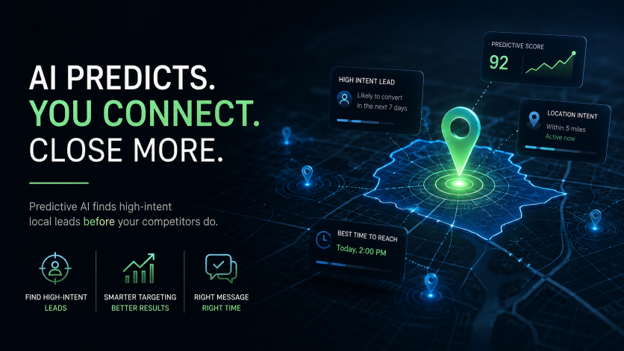
According to a 2023 McKinsey & Company report on AI adoption, companies that integrate AI into their marketing functions report significantly higher rates of lead conversion than those relying on traditional demographic targeting alone. For businesses competing in local markets, that gap is not abstract – it shows up in wasted ad spend, missed follow-up windows, and prospects who chose a competitor before you knew they were looking.
Predictive lead generation is the practice of using AI models trained on behavioral, geographic, and intent data to identify which prospects are most likely to convert – before they make contact. Instead of waiting for a lead to raise their hand, predictive systems surface high-probability prospects based on patterns, timing, and context. The result is a shorter sales cycle, more efficient spend, and marketing that reaches the right person at the right moment.
Key Takeaways
- Predictive lead generation works by modeling behavioral signals, not just demographics – it identifies when someone is likely to act, not just who they are.
- Location-based intent data allows businesses to target prospects within specific geographic windows at the moment of highest purchase readiness.
- AI-powered campaign automation reduces manual decision-making by triggering the right message based on real-time behavioral thresholds.
- Small businesses benefit disproportionately from predictive models because they allow precision targeting without the budget scale that traditional broad-reach advertising requires.
- Predictive systems require clean, consistent data inputs to function accurately – implementation without a data audit often produces worse results than the status quo.
Why Is Traditional Lead Generation Failing Local Businesses Right Now?
Most local lead generation still operates on a spray-and-hope model. A business defines a geographic radius, selects a demographic bracket, and runs ads to everyone inside those parameters. The assumption baked into this model is that proximity plus demographics equals intent.
That assumption has always been weak. Now it’s expensive.
Consumer behavior has shifted toward high-specificity, moment-driven searches. According to Google’s research on micro-moments, consumers make purchase decisions in brief windows of intense intent – searching for “near me” results, asking voice assistants for recommendations, or comparing options on mobile in real time. A business targeting a zip code with a static ad campaign is not competing in that window. It’s competing in a different game entirely.
The real problem is not that local businesses lack reach – it’s that they’re optimizing for presence when they should be optimizing for timing.
What Is Actually Causing the Conversion Gap – and Why Doesn’t More Advertising Fix It?
The root cause is a structural mismatch between how leads are generated and how purchase decisions are actually made.
Traditional lead generation captures contact information. Predictive lead generation captures behavioral momentum. Those are fundamentally different things. A contact captured through a static form may be weeks away from a decision. A prospect flagged by a predictive model based on search frequency, content engagement, and location proximity may be hours away.
The conversion gap persists because most businesses are measuring volume – how many leads came in – rather than velocity – how close each lead is to a decision at the moment of first contact. More advertising increases volume. It does nothing for velocity.
Predictive lead generation does not find you more prospects. It finds you the right prospects at the moment they are most likely to say yes – and that distinction is worth more than any increase in raw lead volume.
This is why companies that double their ad spend without changing their targeting model often see diminishing returns. The problem was never reach. It was relevance and timing.
How Does Predictive AI Actually Analyze Customer Behavior?
Predictive AI models for lead generation are trained on layered data inputs: historical purchase behavior, on-site engagement patterns, search query sequences, geographic movement data where available and consented, and third-party intent signals from data partners.
The mechanism works like this: the model identifies patterns that preceded conversions in the past, then scans current prospect behavior for those same patterns. When a threshold of matching signals is crossed, the prospect is flagged as high-intent.
This is not guesswork dressed up in technical language. It is pattern recognition at a scale no human analyst can replicate manually.
The behavioral signals that matter most are sequences, not single actions. A prospect who visits a pricing page once is not the same as a prospect who visits a pricing page, reads two case studies, and then searches for a competitor comparison within 72 hours. The second pattern has a conversion probability multiple times higher. Predictive models catch that sequence. Static demographic targeting does not.
Practitioners using this approach – including clients working with AI Geo Elite – report that scoring leads by behavioral sequence rather than contact recency alone consistently improves the quality of outreach, reducing time spent on cold follow-up.
The Predictive Readiness Scorecard: Are You Ready to Deploy AI-Driven Lead Models?
Not every business is ready to implement predictive lead generation immediately. The Predictive Readiness Scorecard is a diagnostic framework for assessing implementation readiness before committing resources.
| Readiness Factor |
Ready |
Needs Work |
Not Ready |
| CRM data history (12+ months) |
Clean, consistent records |
Partial or inconsistent |
No CRM or minimal data |
| Website behavioral tracking |
Full event tracking installed |
Basic pageview only |
No analytics |
| Geographic targeting clarity |
Defined service radius or zones |
Broad or undefined |
No local focus |
| Campaign automation capability |
Automation platform in use |
Manual with some tools |
Fully manual |
| Content for intent stages |
Top, mid, and bottom-funnel assets |
Some content gaps |
Single-stage content only |
Use this when: You are evaluating whether to invest in predictive tools or need to sequence your preparation steps.
Not when: You are in the first 6 months of business with no conversion history – predictive models require historical data to train on. Without it, you are not running a predictive model; you are running a hypothesis.
Does Location-Based Marketing Actually Work Differently With Predictive AI?
Yes. And the difference is more significant than most marketers expect.
Standard location-based marketing targets people inside a geographic boundary. Predictive location-based marketing targets people inside a geographic boundary who are currently exhibiting high-intent behavioral signals. The distinction cuts wasted impressions dramatically.
A concrete example: a regional home services company running standard geo-targeted ads might reach 10,000 households in a 15-mile radius. Of those, industry data suggests a small fraction are actively considering a purchase in any given week. A predictive model trained on search behavior, seasonal patterns, and prior customer data can narrow that 10,000 to a few hundred high-probability prospects – the ones whose behavioral sequence matches the pattern that preceded past conversions.
The same budget. A fraction of the audience. A substantially higher conversion rate.
AI Geo Elite’s approach to location-based optimization layers natural language processing signals –
voice search queries, question-based searches, and conversational intent patterns – on top of geographic data. This captures the prospect who asked their phone “who does HVAC repair near me” and is ready to book today, not the person who might need service in three months.
Location is not a targeting strategy. Location plus behavioral timing is a targeting strategy.
How Does AI-Powered Campaign Automation Fit Into This?
Predictive lead generation identifies the right prospects. Campaign automation acts on that identification without human delay.
The mechanism matters here. When a prospect crosses a behavioral threshold – say, three high-intent signals within a 48-hour window – an automated campaign can trigger a personalized outreach sequence within minutes. Human-managed campaigns typically respond in hours or days. Research on lead response time, including data cited by Harvard Business Review, consistently shows that response speed is one of the strongest predictors of conversion success. The difference between a 5-minute response and a 24-hour response is not incremental – it is often the difference between winning and losing the prospect entirely.
Automation does not replace judgment. It removes the delay between signal and response – which is where most conversions are lost.
Small businesses benefit from this disproportionately. A solo operator or a team of five cannot monitor behavioral signals manually and respond in real time. Automation makes that capability available regardless of team size.
What Are the Real Limitations of Predictive Lead Generation?
Predictive lead generation is not a universal solution. Stating this plainly builds more trust than glossing over it.
It does not work well for businesses with fewer than 12 months of conversion data. The models need historical patterns to identify. Without them, you are training on noise.
It is not a substitute for a functional sales process. Predictive tools surface high-intent prospects. If your follow-up process is broken, faster identification just accelerates your exposure to that problem.
It requires ongoing data hygiene. A predictive model trained on dirty CRM data will produce confident-sounding but inaccurate scores. Garbage in, garbage out – this is not a cliché in data science; it is a documented failure mode.
And it is not appropriate for businesses whose purchase cycles are inherently long and relationship-driven, where a single behavioral sequence means very little. High-consideration B2B sales with 12-month cycles are a poor fit for the same models that work well in local services, e-commerce, or high-frequency consumer decisions.
Frequently Asked Questions
How long does it take before a predictive lead generation model starts producing usable results?
Most implementations require 60 to 90 days before the model has processed enough behavioral data to produce reliable scoring. The first month is largely setup and data integration. Practitioners report that meaningful conversion improvement typically becomes visible in month three, with stronger results by month six as the model refines against real outcomes.
Do I need a large marketing budget for predictive lead generation to be worth it?
No. Predictive models are particularly valuable for businesses with constrained budgets because they reduce wasted spend rather than requiring increased spend. The efficiency gain comes from targeting precision, not volume. A business spending a modest amount on highly targeted outreach will consistently outperform one spending multiples of that on broad-reach campaigns.
What kind of data does predictive AI actually need to work?
At minimum: historical conversion records, website behavioral data with event tracking, and a CRM with consistent contact and outcome logging. Third-party intent data and voice search signals can be layered in once the foundation is solid. The quality of the data matters more than the quantity.
Is predictive lead generation the same as buying a lead list?
No – and the difference is fundamental. A purchased lead list gives you contact information for people who fit a demographic profile. Predictive lead generation identifies people currently exhibiting behavioral signals that indicate purchase readiness. One is a static snapshot. The other is a live signal.
How does voice search factor into predictive lead generation for local businesses?
Voice search queries are phrased as questions and carry strong intent signals – “who can fix my furnace today” is a different signal than a typed search for “HVAC companies.” AI Geo Elite specifically optimizes for these natural language patterns, which means predictive models can incorporate voice search behavior as a high-weight intent indicator for local prospects.
Can a small business implement this without a dedicated data team?
Yes, with the right partner. AI Geo Elite structures implementations that don’t require in-house data science capacity. The key is having a consultant who can manage the model configuration, data integration, and campaign automation setup – leaving the business owner to focus on the sales conversations that result.
What happens if the predictive model starts scoring the wrong prospects?
Model drift is a real phenomenon – patterns change as consumer behavior evolves. The fix is regular model retraining against recent conversion outcomes, typically quarterly. A well-managed predictive system includes monitoring for scoring accuracy and recalibrates when conversion rates on high-scored leads begin to decline. This is a maintenance requirement, not a one-time setup.
What Should You Do If You’re Ready to Stop Guessing About Your Next Customer?
If you have read this far, you are not looking for more content about lead generation. You are evaluating whether predictive AI is the right move for your business right now – and whether you have the right partner to implement it without wasting the next six months on a misconfigured tool.
AI Geo Elite works with businesses at exactly this decision point. The starting place is an
AI lead strategy consultation – a focused session that maps your current data assets against the Predictive Readiness Scorecard, identifies your highest-value intent signals, and outlines a realistic implementation path with honest timelines.
Schedule your AI lead strategy consultation today. Come with your current lead conversion numbers and your biggest targeting frustration. Leave with a clear picture of what predictive lead generation can actually do for your business – and what it cannot.
References
- McKinsey & Company – Research on AI adoption in marketing functions and performance outcomes across industries.
- Harvard Business Review – Research and analysis on lead response time and its relationship to conversion rates.
- Google – Micro-moments research on consumer decision-making behavior and mobile search intent patterns.