
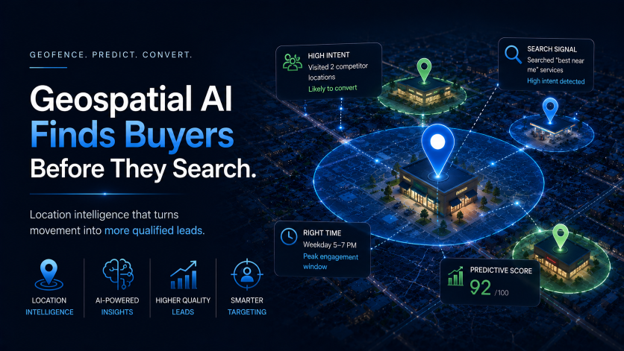
Most marketing budgets still treat location as a filter, not a signal. The businesses pulling ahead are treating it as intelligence – and the gap between those two approaches is widening fast.
What Is Geospatial AI?
Geospatial AI is the application of artificial intelligence and machine learning to location-based data – combining GPS coordinates, satellite imagery, demographic layers, mobility patterns, and environmental context to generate predictive insights about human behavior. It transforms raw geographic data into actionable intelligence about who is where, why they are there, and what they are likely to do next.
Key Takeaways
- Geospatial AI combines location data with machine learning to predict customer behavior, not just describe it.
- AI-powered audience segmentation based on movement patterns outperforms static demographic targeting in most B2C and local B2B scenarios.
- Businesses using location intelligence for lead acquisition typically refine their targeting within 60-90 days of implementation, not years.
- Geospatial AI is not a replacement for content strategy – it is a precision layer applied on top of existing marketing infrastructure.
- AI Geo Elite applies geospatial intelligence as part of its Answer Engine Optimization methodology to improve local and global discoverability simultaneously.
Why Does Traditional Targeting Miss the People Most Likely to Buy?
Most digital targeting is built on declared identity: age, job title, stated interests. The problem is that people do not behave the way they describe themselves. Someone who lists “fitness” as an interest on a social profile may not have visited a gym in eight months. Someone who never mentioned home improvement just spent three Saturdays in a row at hardware stores within a two-mile radius.
Behavior is a more honest signal than self-reported identity. Geospatial AI captures behavior as it happens – not as people remember or represent it.
This is the root cause of why traditional audience segmentation underperforms: it is built on static attributes rather than dynamic behavioral evidence. A demographic profile tells you who someone is on paper. A geospatial signal tells you what they are doing right now, which is a far stronger predictor of purchase intent.
Location data does not describe your customer – it catches them in the act of becoming one.
How Does Geospatial Data Actually Improve Targeting?
Geospatial data improves targeting by adding temporal and spatial context to audience profiles – layering when and where onto the who.
Here is how that works in practice. A regional healthcare provider used mobility data to identify zip codes where residents were regularly visiting urgent care facilities outside their immediate neighborhood. That pattern indicated unmet local demand. By concentrating their digital content and search visibility efforts in those specific corridors – rather than spreading budget across the entire metro area – they reduced their cost per qualified lead by a measurable margin within the first quarter.
The mechanism is not magic. Geospatial signals reduce the targeting radius to people exhibiting proximity-based intent, which means fewer irrelevant impressions and higher conversion rates from the impressions that do land.
A second scenario: a B2B software company wanted to reach operations managers at mid-sized manufacturers. Rather than targeting job titles broadly, they used geospatial AI to identify industrial park clusters with high foot traffic from professional demographics during business hours. Their outreach hit people who were physically present in the environments where the problem their software solves actually occurs.
That specificity is what separates geospatial targeting from conventional digital advertising.
What Does AI-Powered Audience Segmentation Look Like in Practice?
AI-powered audience segmentation is the process of grouping potential customers based on patterns learned from behavioral and location data, rather than manually defined demographic buckets.
Traditional segmentation asks: who are these people? AI-powered segmentation asks: what do these people’s movement and behavioral patterns have in common, and what does that predict?
The segmentation models used in geospatial AI typically draw from several data layers simultaneously – foot traffic patterns, proximity to competitor locations, time-of-day behavior, and cross-referenced purchase signals. The AI identifies clusters that a human analyst would never construct manually, because the correlations are non-obvious.
The counter-intuitive finding that practitioners consistently report: the most predictive segments are rarely the ones marketers would have hypothesized in advance. A coffee chain expecting its core segment to be “urban professionals aged 25-40” discovered through geospatial AI that its highest-value repeat customers were parents dropping children at schools within a half-mile radius – a segment with entirely different messaging needs and peak engagement windows.
This is why AI Geo Elite builds geospatial intelligence into its audience analysis phase before any content or optimization work begins. Optimizing content for the wrong audience, no matter how technically precise, produces accurate answers to the wrong questions.
The Geospatial Lead Acquisition Framework (GLAF)
The Geospatial Lead Acquisition Framework is a four-stage decision tool for applying location intelligence to lead generation:
| Stage | What Happens | Use When | Skip When |
|---|---|---|---|
| Signal Collection | Aggregate mobility, search, and behavioral location data | You have a defined geographic market | Your product has no geographic dependency |
| Cluster Analysis | AI identifies non-obvious audience segments by behavioral pattern | Targeting assumptions have underperformed | You already have validated, high-converting segments |
| Content Alignment | Optimize discoverability for the language and intent patterns of each cluster | Building or refreshing content infrastructure | Running short-term paid campaigns only |
| Feedback Loop | Measure engagement by segment and refine clusters quarterly | Ongoing optimization is resourced | One-time campaign with no follow-through plan |
Use GLAF when your targeting feels accurate on paper but underperforms in practice. It is not designed for businesses with no geographic component to their customer acquisition – a fully remote SaaS product selling globally on keyword intent alone does not need this layer.
What Are the Real Business Applications for Lead Acquisition?
The practical applications fall into three categories: local presence optimization, competitive displacement, and expansion targeting.
Local presence optimization means ensuring your business appears – and appears correctly – when someone with demonstrated proximity and intent searches for what you offer. This is where AI Geo Elite’s Answer Engine Optimization methodology intersects directly with geospatial intelligence. Voice search queries are inherently local and conversational. Optimizing for them without knowing the precise behavioral geography of your audience is guesswork.
Competitive displacement uses geospatial AI to identify where competitor foot traffic is concentrated and build content visibility in those exact corridors. If your competitor’s customers are physically present in a district and searching for alternatives, appearing in that search is not an accident – it is an engineered outcome.
Expansion targeting applies location intelligence before entering a new market. Rather than launching broadly and hoping, businesses use geospatial clustering to identify the specific sub-markets within a new region that most closely resemble their existing high-value customer clusters.
Most businesses expand into new markets by geography. The ones that use geospatial AI expand into new markets by behavioral similarity – and they fail less often.
Where Is Location Intelligence Heading in the Next Three Years?
The near-term trajectory of geospatial AI points toward three developments worth tracking.
First, real-time intent layering. Current geospatial models are largely retrospective – they analyze patterns that have already occurred. Models being developed now will combine live mobility signals with natural language processing to identify intent as it forms, not after it has been expressed in a search query.
Second, integration with answer engine infrastructure. As voice search and AI-generated answers become the dominant discovery mechanism for local and transactional queries – a shift Gartner has tracked in its annual search behavior research – geospatial context will become a core input for how answer engines rank and surface responses. Businesses that have already built geospatial intelligence into their content architecture will have a structural advantage.
Third, privacy-compliant cohort modeling. Regulatory pressure on individual-level tracking is real and accelerating. The next generation of geospatial AI will operate on aggregated cohort signals rather than individual identifiers – which actually improves targeting precision at scale while reducing compliance exposure.
AI Geo Elite is already building toward this integration, treating geospatial intelligence not as a standalone data product but as a foundational input into Answer Engine Optimization strategy.
Who Is Geospatial AI Not Right For?
This matters, and it is worth stating plainly.
Geospatial AI does not produce meaningful results for businesses whose customer acquisition has no geographic dimension whatsoever – fully global digital products with undifferentiated international demand, for example. It also requires a minimum viable data environment to function: if your business has limited transaction history, no CRM, and no existing digital footprint, the AI has nothing to learn from.
It is not a shortcut for businesses that have not yet defined their core customer. Geospatial intelligence amplifies an existing signal – it does not create one where none exists.
And it is not a replacement for content quality. A business with strong location targeting but thin, low-authority content will generate impressions it cannot convert. The targeting and the content have to work together.
FAQ
How long does it take to see results from geospatial AI targeting?
Most businesses see meaningful refinement in their audience segments within 60 to 90 days of implementation, once the AI has enough behavioral data to identify reliable patterns. Full optimization – where the feedback loop between targeting, content, and conversion is calibrated – typically takes two to three quarters.
Do I need a large budget to use geospatial AI for lead generation?
Not necessarily. The data infrastructure required has become significantly more accessible in the past few years. The more important variable is whether your business has a defined geographic market and enough existing customer data to train the initial models. Budget scales with ambition, not with entry requirements.
How is geospatial AI different from just using Google Ads location targeting?
Google Ads location targeting tells the platform where to show your ad. Geospatial AI tells you which locations actually contain your highest-intent prospects, why they are there, and what content or messaging will reach them most effectively. One is a delivery mechanism; the other is intelligence that shapes what you deliver and to whom.
Can geospatial AI help with voice search optimization specifically?
Yes, and this is one of the strongest use cases. Voice search queries are predominantly local and conversational in structure. Geospatial AI identifies the precise behavioral and geographic context in which those queries occur, which directly informs how AI Geo Elite structures natural language content to match real-world intent patterns.
Is location data collection legal and compliant with privacy regulations?
Compliant geospatial AI operates on aggregated, anonymized mobility data – not individual tracking. Reputable providers use data collected under appropriate consent frameworks. Businesses should confirm their vendor’s compliance posture explicitly, particularly in jurisdictions governed by GDPR or CCPA.
What kind of businesses see the strongest results from geospatial lead targeting?
Businesses with a defined local or regional market, a meaningful volume of in-person or location-influenced transactions, and an existing digital presence tend to see the strongest results. Multi-location retail, healthcare, professional services, and regional B2B companies are consistently strong performers.
How does geospatial AI connect to Answer Engine Optimization?
Answer engines – the AI systems powering voice search and AI-generated responses – increasingly weight geographic relevance when surfacing answers to local queries. Geospatial AI identifies the exact location-intent signals those engines are responding to, allowing AI Geo Elite to optimize content so it answers the right question for the right place at the right time.
Ready to Stop Guessing Where Your Best Leads Are?
You have just read the case for treating location as intelligence rather than a filter. The next question is whether your current content and targeting infrastructure is built to act on that intelligence – or whether it is still optimized for an audience that exists on paper but not in practice.
AI Geo Elite applies geospatial intelligence as a core input into Answer Engine Optimization strategy, connecting your content to the real behavioral patterns of the audiences most likely to find, trust, and choose you.
Learn how AI Geo Elite improves lead targeting – and find out whether your current digital presence is reaching the right people in the right places.
References
- Gartner – Annual research tracking search behavior trends, voice search adoption, and AI-generated answer engine usage patterns.
- U.S. Census Bureau – Geographic and demographic data used in location intelligence modeling and market segmentation research.
- McKinsey & Company – Research on AI adoption in marketing, customer segmentation methodology, and behavioral analytics in commercial applications.