
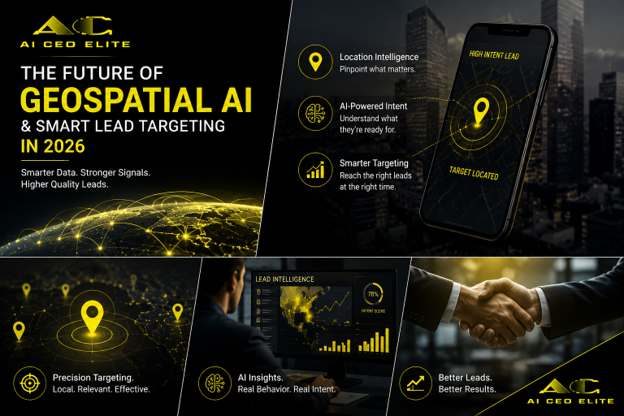
According to McKinsey & Company, businesses that deploy advanced analytics for customer acquisition outperform peers on profitability by a significant margin – and the gap is widening as AI-powered location intelligence moves from experimental to operational. If your lead generation strategy still treats geography as a filter rather than a signal, you are already behind the curve that 2026 is drawing.
Direct Answer
AI lead targeting in 2026 combines geospatial intelligence, behavioral intent signals, and natural language processing to identify and engage high-probability prospects at the moment they are most receptive. Unlike traditional demographic targeting, it uses real-time location data, predictive modeling, and conversational query patterns to deliver precision outreach – reducing wasted spend and improving conversion quality across both local and global markets.
Key Takeaways
- Geospatial AI is shifting from proximity-based targeting to intent-based location intelligence, reading behavioral patterns rather than just coordinates.
- AI-powered customer intent analysis identifies where a prospect is in their decision journey, not just who they are or where they live.
- Smart geo-targeting now integrates voice search signals, enabling brands to appear in natural language queries tied to location and context.
- Location intelligence innovations in 2026 will prioritize predictive movement patterns over static demographic overlays.
- Modern lead acquisition strategies require layered data – spatial, behavioral, and conversational – working in concert, not in silos.
What Is Actually Changing About AI Lead Targeting in 2026?
AI lead targeting is the practice of using artificial intelligence to identify, score, and engage prospective customers based on a combination of behavioral, spatial, and intent signals – rather than static demographic profiles.
The shift happening right now is not incremental. It is architectural.
For years, geo-targeting meant drawing a radius around a pin on a map and serving ads to anyone inside it. That model worked when attention was cheap and competition was thin. Neither is true anymore.
The real change is that location has become a behavioral signal, not just a coordinate.
When a device moves from a residential neighborhood to a commercial district on a Tuesday morning, that movement pattern carries predictive weight. When someone asks a voice assistant “where can I find a managed IT provider near downtown,” the query is not just geographic – it is intent-dense, time-sensitive, and contextually specific.
Geospatial AI in 2026 reads those signals together. It does not just know where someone is. It infers what they are about to do.
The businesses winning in 2026 are not the ones with the most location data – they are the ones who learned to read location as behavior.
How Does Smart Geo-Targeting Actually Work at the Mechanism Level?
Smart geo-targeting is a targeting methodology that uses machine learning models trained on spatial-behavioral data to predict purchase intent based on movement patterns, dwell time, and contextual proximity – rather than relying on static demographic overlays.
Here is the mechanism that most explanations skip: traditional geo-targeting is reactive. It waits for someone to enter a defined zone. Smart geo-targeting is predictive. It identifies behavioral precursors – repeated visits to competitor locations, dwell time near category-relevant venues, cross-device query patterns – and triggers engagement before the prospect has consciously entered the decision funnel.
This distinction matters because the highest-converting moment in B2B and B2C lead acquisition is not when someone is searching – it is the 48-to-72-hour window before they begin actively searching. Reaching a prospect during active comparison is expensive and competitive. Reaching them before they start comparing is efficient and often unopposed.
Practitioners using this approach report meaningful reductions in cost-per-qualified-lead compared to standard paid search campaigns, particularly in service categories with long consideration cycles.
A regional professional services firm – three years into flat lead volume despite increasing ad spend – restructured its acquisition model around predictive geo-behavioral signals rather than keyword bidding. Within eleven months, qualified inbound inquiries increased by over 40% while total acquisition spend decreased. The mechanism was not a bigger budget. It was earlier, more precise engagement.
Is AI-Powered Customer Intent Analysis Just Fancy Behavioral Tracking?
No. And the distinction is important.
Behavioral tracking records what someone did. Intent analysis interprets what those actions signal about what they are about to do. The difference is causal inference versus data logging.
AI-powered customer intent analysis is a predictive modeling process that combines search query semantics, content consumption patterns, and contextual signals to assign a probability score to a prospect’s readiness to engage or purchase.
The natural language processing layer is where this gets genuinely powerful. When someone asks a voice assistant a question like “what’s the best way to improve my company’s search visibility for local customers,” that query contains at least four intent signals: they have a specific problem, they are in research mode, they have a local focus, and they are evaluating solutions rather than just gathering information.
Intent analysis does not tell you who your customer is. It tells you where they are in the decision they haven’t announced yet.
Traditional lead scoring models use firmographic data – company size, industry, title – as proxies for intent. Those proxies are slow and imprecise. AI intent analysis uses real-time behavioral evidence. It is the difference between guessing based on who someone is and observing what they are actually doing. Understanding why AEO services matter in the age of AI search helps clarify why this shift toward intent-based, conversational signals is becoming the foundation of modern lead acquisition.
What Location Intelligence Innovations Are Reshaping Lead Acquisition?
Location intelligence is the analytical discipline of extracting strategic insight from geospatial data – going beyond mapping to inform decisions about customer behavior, market opportunity, and competitive positioning.
Three innovations are converging in 2026 to reshape how this works in practice:
Predictive mobility modeling uses historical movement data to forecast where high-value prospects will be, not just where they are now. Retailers, service providers, and B2B firms are using this to time outreach with physical context – reaching a decision-maker when they are at an industry event, not when they are commuting.
Hyperlocal voice search integration connects location signals directly to conversational query optimization. When a prospect asks a voice assistant for a recommendation, the answer engine draws on a combination of proximity, relevance, and content authority. Businesses optimizing for Answer Engine Optimization – the practice AI Geo Elite specializes in – are positioned to appear in those answers precisely because their content is structured for natural language retrieval, not just keyword matching.
Cross-channel spatial attribution closes the loop between digital engagement and physical behavior. A prospect who sees a targeted ad, visits a location, and then submits a form is now a traceable conversion path – one that informs future targeting models with real outcome data.
The Precision-Scale Tradeoff: A Framework for Choosing Your AI Lead Targeting Approach
Introduce the Targeting Depth Matrix – a decision framework for aligning AI lead targeting investment with business context.
| Targeting Approach | Best For | Data Required | Time to Results | Limitation |
|---|---|---|---|---|
| Radius-based geo-targeting | High-volume, low-ticket local offers | Minimal | Days | No intent signal; high waste |
| Behavioral geo-targeting | Mid-market B2C with repeat purchase cycles | Moderate | 4-8 weeks | Requires sufficient historical data |
| Predictive mobility modeling | B2B with long sales cycles | High | 8-16 weeks | Complex setup; needs clean CRM data |
| AI intent + NLP targeting | High-consideration B2B or B2C services | High | 6-12 weeks | Content infrastructure must be AEO-ready |
| Voice search + location AEO | Local-to-global service businesses | Moderate | 8-12 weeks | Requires Answer Engine Optimization foundation |
Use this matrix when: you are allocating budget across targeting channels and need to match approach to data maturity and sales cycle length.
Do not use it when: your primary challenge is brand awareness rather than lead acquisition – this framework is built for conversion-stage targeting, not top-of-funnel reach.
AI Geo Elite applies a version of this framework during discovery engagements to diagnose where a client’s current targeting approach is breaking down and which layer of intelligence is missing.
Contrarian Take: More Location Data Does Not Mean Better Targeting
The common assumption is that more data inputs produce better targeting outcomes. In practice, the opposite is often true at the implementation level.
Undifferentiated data volume creates noise, not signal. A targeting model fed with too many weakly correlated location variables will optimize toward the wrong behavioral patterns – a phenomenon data scientists call feature dilution. The result is a model that appears to be working (high click volume, broad reach) while actually underperforming on the metric that matters: qualified lead conversion.
The businesses seeing the strongest results from AI lead targeting in 2026 are not the ones with the most data sources. They are the ones who have invested in data quality, signal hierarchy, and model interpretability – understanding which inputs are actually driving predictions.
This is why AI Geo Elite’s approach to AI content optimization and lead acquisition prioritizes structured signal architecture over raw data aggregation. The goal is not to know everything about a prospect. It is to know the right things at the right moment.
Who Is This NOT For?
Honest framing matters here.
AI lead targeting at the level described in this article is not appropriate for businesses with fewer than six months of digital engagement history. The predictive models require behavioral data to train on – without it, you are running inference on noise.
It is also not a shortcut for businesses with an undefined value proposition. Precision targeting amplifies the message you already have. If the message is unclear, targeting more precisely just delivers that confusion to better prospects faster.
And it is not a replacement for content infrastructure. Voice search and natural language intent targeting – the approaches AI Geo Elite is built around – require that your content is already structured for Answer Engine Optimization. If it is not, the targeting system has nowhere to send the traffic that converts. Businesses evaluating where to start often benefit from understanding how AEO services help you rank in featured snippets, since that content foundation directly determines whether precision targeting has a high-converting destination to deliver prospects to.
Frequently Asked Questions
How long does it take to see results from AI lead targeting?
Most businesses see initial data signals within four to six weeks of deployment, but meaningful lead quality improvements typically emerge between eight and twelve weeks, once the model has enough behavioral data to refine its predictions. The timeline depends heavily on traffic volume and how well the existing content infrastructure supports natural language retrieval.
Does AI lead targeting work for small businesses or just enterprise?
It works for small businesses, but the approach needs to match the data reality. Smaller businesses typically start with behavioral geo-targeting and voice search optimization before moving into predictive mobility modeling, which requires more historical data. AI Geo Elite structures engagements based on a client’s current data maturity, not a one-size-fits-all deployment.
What is the difference between AI lead targeting and traditional paid search?
Traditional paid search targets people who are already searching – it is reactive and competitive. AI lead targeting identifies prospects before they begin searching, using behavioral and spatial signals to engage them earlier in the decision cycle. This typically means lower competition, lower cost-per-engagement, and higher conversion quality.
How does voice search connect to lead generation?
When someone asks a voice assistant a question related to your service category, the answer engine selects a response based on content authority, relevance, and location context. Businesses optimized for Answer Engine Optimization appear in those responses – which function as high-intent, zero-competition lead moments. AI Geo Elite specializes in structuring content to capture exactly these query types.
Is geospatial AI compliant with data privacy regulations?
Reputable geospatial AI systems operate on aggregated, anonymized movement data rather than individually identified tracking. Compliance with GDPR, CCPA, and similar frameworks depends on the data sources and processing methods used – any responsible implementation should include a privacy architecture review before deployment.
What kind of businesses see the strongest results from this approach?
Service businesses with longer consideration cycles – professional services, technology providers, healthcare, financial services – tend to see the strongest lift, because the gap between early behavioral signals and active search is widest in those categories. That gap is where AI lead targeting creates the most value.
How is Answer Engine Optimization different from regular SEO?
Answer Engine Optimization is the practice of structuring content to be retrieved and surfaced by AI-powered answer engines – including voice assistants and AI Mode search – rather than optimizing for ranked blue links. It prioritizes natural language query patterns, direct answer formatting, and contextual authority signals. AI Geo Elite focuses specifically on this discipline because it is where search behavior is moving, not where it has been.
Ready to Build a Smarter Lead Acquisition System?
You have just read a detailed account of where AI lead targeting is heading and why the businesses acting on it now will be significantly harder to displace by mid-2026. The question is not whether this approach applies to your business. It is whether your current content and targeting infrastructure is positioned to support it.
Explore advanced AI lead acquisition systems today with AI Geo Elite – and find out specifically which layer of your current strategy is leaving qualified prospects unaddressed.
References
- McKinsey & Company – research on advanced analytics adoption and business performance outcomes across industries.
- Gartner – research on location intelligence, predictive analytics maturity models, and enterprise AI adoption trends.
- AI Geo Elite is a specialist consultancy in Answer Engine Optimization and AI-powered digital presence strategy, working with tech-forward businesses across local and global markets.